•
Training and Development Framework
It is the Group’s policy to train employees at all levels so
that they would be able to perform well in their present jobs
and also to develop employees who are considered to have
the potential to perform duties with wider responsibilities
so that they may be ready to assume them when needed.
Programmes are also implemented to ensure that employees
receive continuous training in various areas of work such as
knowledge, health and safety, technical training, leadership
and new product development.
•
Talent Development and Succession Planning
There is a Group Talent Management Framework in place
to identify and develop a group talent pipeline within the
organisation as a supply for future leadership demands.
In this respect, the Group has met its target of identifying
C-suite potentials that provides a cover ratio of 2:1, from
within the organisation and has been intensifying its efforts
in making these talent ready to succeed the current top
management across the Group. This is done via structured
leadership development programmes, mentoring and
coaching, regular leadership readiness assessments, as well
as cross-functional and cross-country assignments.
This leadership talent pipeline is also regularly reviewed
via the Group Talent Council and assessed as potential
successors for key positions in the Group, via internal and
external benchmarks.
Succession plans and the robustness of the talent pipeline
are regularly reviewed by the Board. The talent pipeline
includes fresh graduates and middle management levels
so as to ensure a continuous supply of talent. As of 31
December 2015, seven internal successors have been at
placed top positions across the Group.
2.0 Risk Assessment
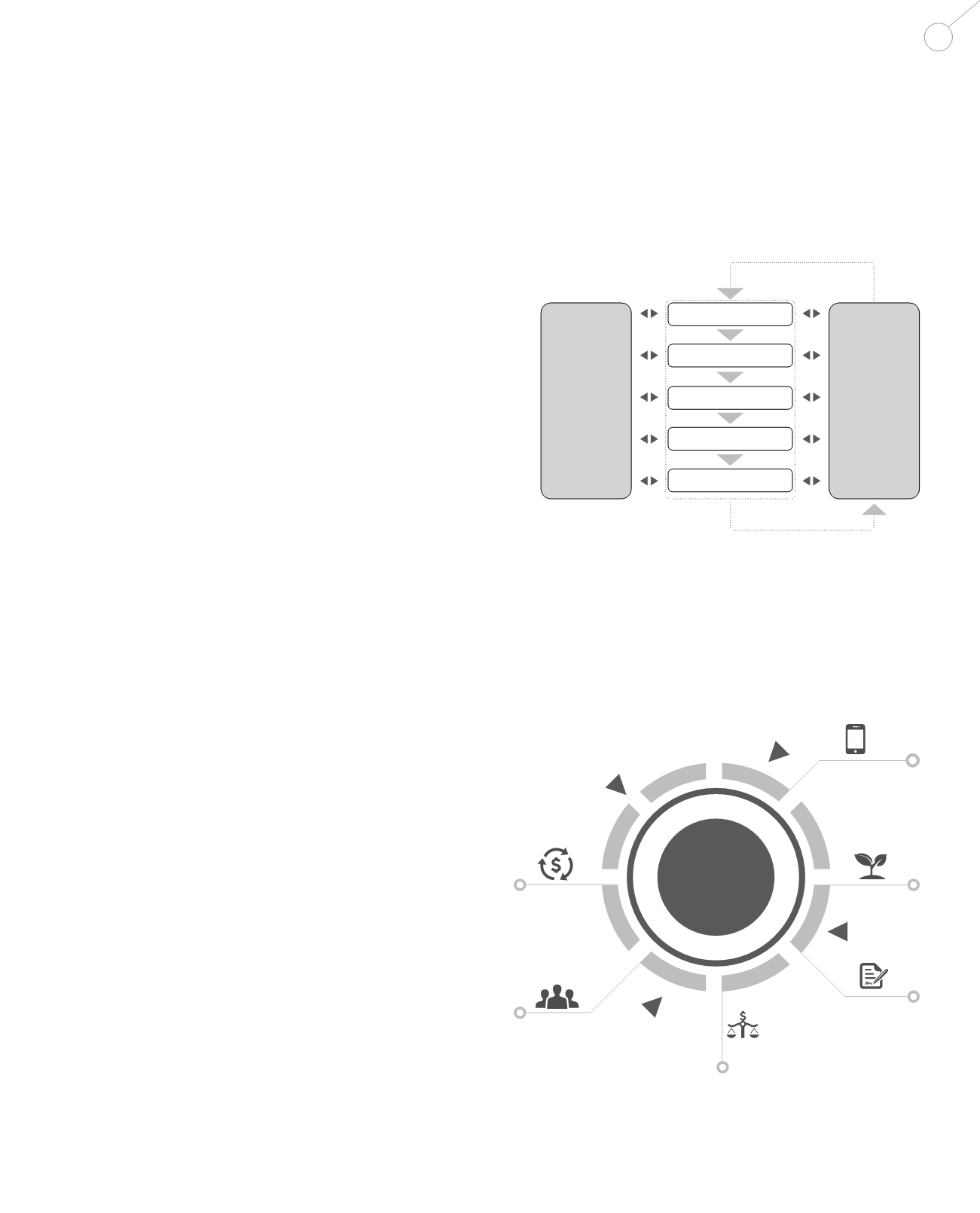
Axiata’s risk management process is guided and principally aligned to
ISO31000:2009 where risk is managed to ensure the achievement and
implementation of strategic objectives. The Group’s risk management
process typically involves identifying particular events or circumstances
relevant to the organisation’s objectives and risk appetite, assessing
them in terms of likelihood and magnitude of impact, evaluation of
adequacy of existing controls, determining a response strategy, and
monitoring the implementation of the response. This is expected to
protect and create value for stakeholders, including shareholders,
employees, customers, regulators, and the society.
The risk identification process, which is done on an on-going basis
entails scanning of all key factors within Axiata’s business context from
an ‘outside-in’ perspective, i.e. from macro-environment (external) to
industry and internal risks. Risks are generally classified into distinct
categories, i.e. strategic, financial, operational and compliance,
representing the challenges to the Group’s business operations, as
depicted below:
Axiata’s Risk Assessment Process is depicted in the following diagram:
Process for Managing Risk
Establish Context
Communication
& Consultation
Recording,
Monitoring &
Review
Risk Identification
Risk Analysis
Risk Evaluation
Risk Treatment
Macro
Environment
Technology
Environment
Financial
Strategic
Operational
Regulatory
Economy
Social
Geo Political
Compliance
Internal
Strategy,
Governance,
Financial, People
Operations
S
u
b
s
t
i
t
u
t
e
s
I
n
d
u
s
t
r
y
C
o
m
p
e
t
i
t
o
r
s
V
e
n
d
o
r
s
C
u
s
t
o
m
e
r
s
S
u
p
p
l
y
C
h
a
i
n
axiata group berhad | annual report 2015
077


